

Erasmus+ Outgoing Staff: Teacher and Training Mobility

Titu Maiorescu University is organizing during the period 22.01.2025 – 31.01.2025 Erasmus+ Teaching Mobility (STA) and Training Mobility (STT) enrollment and selection procedure for teaching staff, auxiliary teaching staff, and administrative staff.
The selection of teaching staff is carried out by the Erasmus+ Mobility Selection Committee within each faculty. Applications must be submitted to the Erasmus+ Coordinator of the faculty by 31.01.2025.
The selection of auxiliary teaching staff and administrative staff is carried out by the Central Selection Committee for Erasmus+ mobility. Applications must be submitted to the International Relations Department by 31.01.2025.
The application file must contain the following documents:
- Registration Form;
- Copy of ID/passport;
- Curriculum Vitae;
- Cover letter in English/French;
- Acceptance letter or invitation from the host university (if applicable);
- Mobility Agreement – Staff Mobility for Teaching / Staff Mobility for Training in English. The host institution's signature is optional at the application stage.
The complete Erasmus+ selection procedure for STA/STT mobilities can be accessed here.
For questions and more details, please contact us at the email address erasmus@univ.utm.ro or at the phone number 0213302537.
- Formular de Candidatură pentru mobilități de cadre STA/STT
- Decision of the Senate approving the amendment to the Regulations on mobility within the Erasmus+ Programme and the composition of the Mobility Commissions with its 2 annexes (Commissions)
- Regulation on mobility within the Erasmus+ Programme
- Erasmus+ Program Registration Form
- Mobility Agreement – Staff Mobility for Training
- Mobility Agreement – Staff Mobility for Teaching
- Certificate of Attendance - Model
- Consent statement for the processing of personal data
Stories
Manuela Sîrbu
University Faculty Member at the Law School UTM
„My name is Manuela Sîrbu and I am a university professor at the Faculty of Law – Titu Maiorescu University.
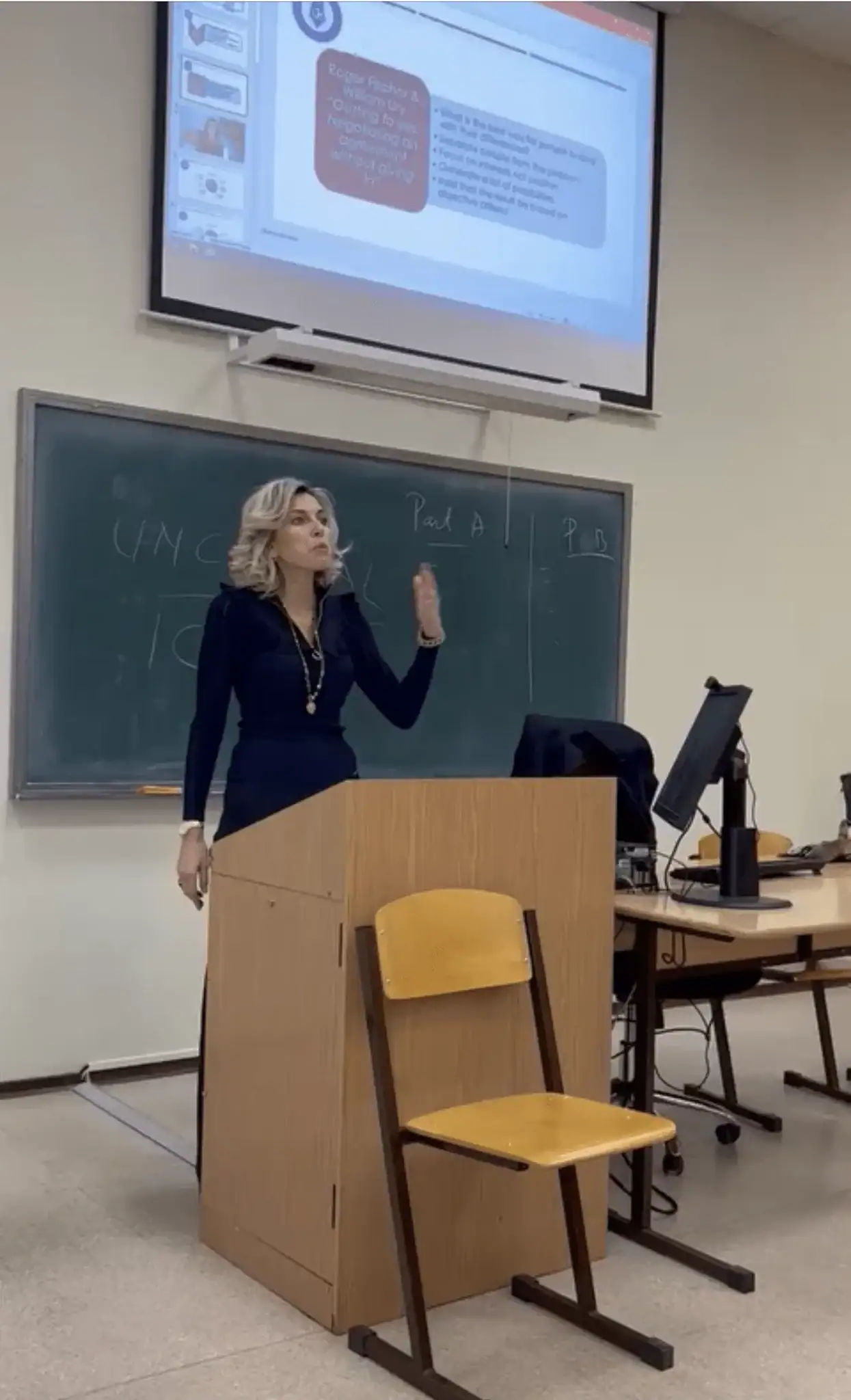
My experience with the Erasmus teaching mobility program in Riga, and specifically at the Baltic International Academy, was extremely valuable for my personal and professional development. Within this mobility, I had the opportunity to interact with a different academic environment.
I met my Latvian colleagues with whom I had interesting debates on teaching techniques and strategies. In the field of alternative dispute resolution, we discussed various topics regulated at the international level and how their legal system positions itself regarding arbitration, mediation, conciliation, negotiation, etc.
During my mobility period, I was involved in teaching activities. Interacting with the Latvian students was a great joy as I quickly discovered their interest in the presented topic. The course was interactive, and I was immensely pleased with their active participation in the classes. They asked me questions, and we discussed various topics of interest related to the subject matter together. Given that I am not a Latvian speaker, I was very happy to find that the students also spoke English, and therefore I did not need a Latvian translator. Thus, my dialogue with the Latvian students was direct, allowing me to express my ideas fluently without the pauses needed for translation, and enabling the students to ask their questions or make their comments directly. I guided and encouraged them to develop their critical, creative, and generative thinking beyond conventional patterns, to be flexible and constructive in their legal approaches.
My experience during this external teaching mobility has significantly impacted my professional growth and personal development. I gained a new perspective on another educational system and it allowed me to test my own professional skills and knowledge in a different academic environment. I sincerely hope to participate in other Erasmus teaching programs to continue my path of professional growth in a European and international context.”