

The classification EXCELLENT awarded to the francophone project «Social Entrepreneurship for Society» (Entrepreneuriat social au service de la Société/EsauSS), initiated by Titu Maiorescu University in Bucharest, in partnership with New Bulgarian University in Sofia and Valahia University of Târgoviște
Titu Maiorescu University implemented the Francophone project from January 2021 to December 2022. «Social entrepreneurship in the service of society» Social Entrepreneurship for the Benefit of SocietyThe project was initiated by our university in partnership with New Bulgarian University in Sofia and Valahia University of Târgoviște, within the framework of the 2020 regional call for projects «Social Entrepreneurship Development Support Mechanism in the University, co-financed by the regional office of AUF for Central and Eastern Europe.
The ESauSS project aimed to enrich social entrepreneurship competencies through an integrative vision, by mobilizing professor-researchers from the region in reflecting on and producing knowledge contextualized to our region's specifics. The dissemination of the project's results to educational and research structures, as well as to civil society, sought to enrich approaches and viewpoints on the social economy, as well as to leverage Francophone expertise in this field. .
Achieving the project objectives was possible through the completion of a coherent set of activities, including:
- Conducting a study on the perception of the social economy in the university environment
- Conducting a comparative study on the regulatory framework for the organization and operation of social economy entities in the region.;
- Organizing two roundtables on the regulatory framework of the social economy, with the participation of field practitioners and civil society representatives;
- Training of 30 trainers in the field of social economy and entrepreneurship and 60 students.;
- Organizing a French-language section at the 2021 Annual Conference of Valahia University of Târgoviște, on Theme: «Social Economy – a factor of revitalization and resilience», which was attended by 50 people and featured 15 presentations;
- Publication of articles and scientific communications, as well as a book.
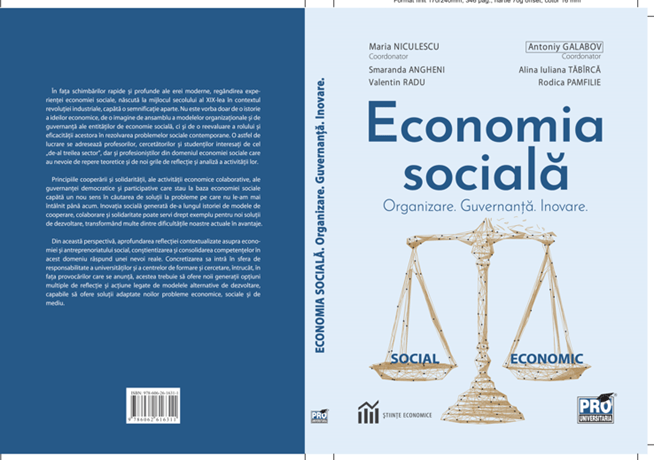
Book «Social Economy. Organization. Governance. Innovation., Published by Pro Universitaria Publishing House, it includes a series of conceptual developments and clarifications related to social economy and social entrepreneurship, treated from three complementary yet interconnected perspectives: organization, governance, and social innovation.
The book is addressed to teachers, researchers, and students interested in this alternative development model, as well as professionals in the social economy field who need theoretical benchmarks and new frameworks for reflection and analysis of their work.
According to the authors, a deeper reflection on social economy and entrepreneurship, as well as raising awareness and strengthening skills in this field, address real, increasingly urgent, and evident needs in the context of the recurring crises our society faces. Its concretization falls within the scope of responsibility of universities and training and research centers, as, in the face of looming challenges, they must offer the new generation multiple options for reflection and action related to alternative development models, capable of providing solutions adapted to new economic, social, and environmental problems.
The project was recently evaluated by the Commission of Economic and Scientific Experts, a statutory advisory body operating within the AUF6 Central and Eastern Europe Regional Directorate. The project received the qualification „EXCELLENT”, on the plan the obtained results and the response to the beneficiaries' needs. According to experts, it is „ a project whose results are concrete and whose objectives have been achieved. The richness of the activities carried out is another positive aspect of the work performed. Project members found the best solutions to challenges related to the pandemic or other contextual constraints. The project report mentions the factors on which its sustainability depends.