

Titu Maiorescu University
Faculty of Law
Annual Session of Student Scientific Communications
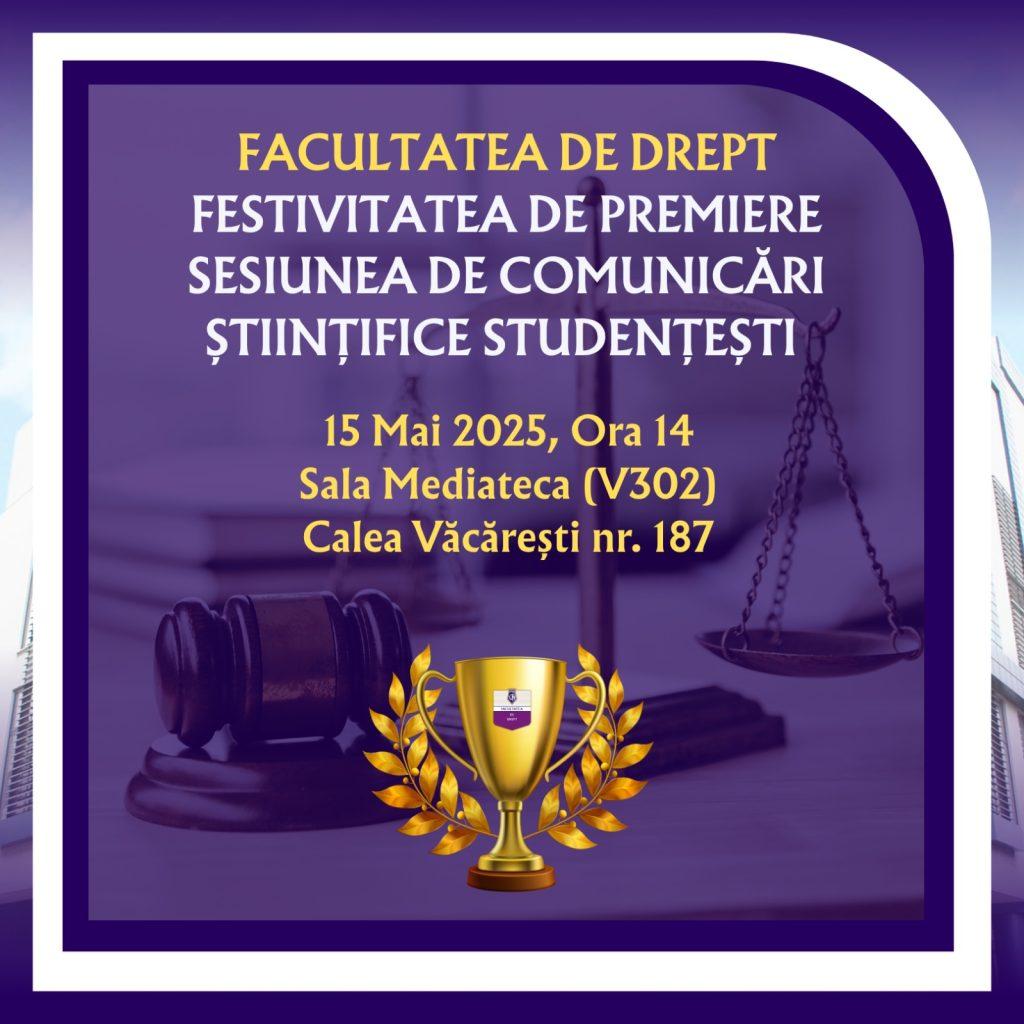
Awards Ceremony – Student Scientific Communications Session, Faculty of Law
The Faculty of Law invites you on Thursday, May 15th at 2 PM to the Awards Ceremony for the Student Scientific Communications Session. The event will take place in building V, at Calea Văcărești 187, in the Media Library room located on the 3rd floor (V302).
We look forward to seeing you!
- Section 1 – Bachelor's and Master's Degree Programs Private Law, Constitutional Law and Administrative Law Panel, Room 209 corp M
- Section 2 – Bachelor's and Master's Study Fields Public law, Room 109 Corp V
- Antonescu Andrei Gabriel, 3rd year ID, Scientific Coordinator: Assoc. Prof. Dr. Manuela Tăbăraș
- Zamfir Ioana-Nicoleta, 2nd year, series A, group 201, scientific coordinator: University Professor Dr. Manuela Tăbăraș
- Lascu Andreea Beatrice, 2nd year, IF, group 207, scientific coordinator: Associate Professor Dr. Petruța Ispas
- Stancu, Denisa Catalina, 2nd year, IF, scientific coordinator: Associate Professor Dr. Ispas Petruța Elena
- Butnaru Răzvan Gabriel, 3rd year, IF, group 303, scientific coordinator: university lecturer Dr. Ioan Morariu
- Andra-Maria Țațără, 4th year IF, Scientific Coordinator: University Lecturer Dr. Andrei Săvescu
- Calu (Ciobotaru) Andra Florentina, Bachelor's degree, III IF, Group 312, scientific coordinator: University Lecturer Dr. Violeta Slavu
- Beatrice-Elena GRIGOROIU, Master's Degree in Civil Law and Civil Procedure with Advanced Studies, Scientific coordinators: Prof. Smaranda Angheni, Assoc. Prof. Mădălina Dinu
- Mihnea-Andrei Stoica, Year I, IF, Series C, Group 112, scientific coordinator: Prof. Univ. Dr. Marieta Safta
- Plopeanu Briana-Ioana, 1st year, IF, scientific coordinators: Prof. Dr. Marieta Safta, PhD candidate Andrei Iacuba
- Tănase Constantin-Iulian, 2nd year, ID, Scientific coordinator: Prof. University Dr. Marieta Safta
- Ionela Viorica Ionică, 2nd year, ID, Scientific coordinator: Prof. University Dr. Marieta Safta
- Antonia Daieanu, 1st year, IF, group 113, scientific coordinator: university professor Dr. Marieta Safta
- Șipoteanu Ilinca, Amul I IF, Group 114, Scientific Coordinator: Professor Marieta Safta
- Petre-Frischherz Georgiana and Radu Lavinia, Year I, IF, Group
- Chirita Laura-Georgiana, Rosu Antonia Luiza Year I, scientific coordinator: Prof. Dr. Marieta Safta
- Țîrlea Laura, Year I, Scientific Coordinator: Prof. Univ. Dr. Marieta Safta
- Robert Caroline, Year I, IF, Group 101, Scientific Coordinator: University Assistant Dr. Daniela Iuliana Radu
- Cojocaru Stefan Aurel, Year 1, IF, Group 104, Scientific Coordinator: Univ. Asst. Dr. Daniela Iuliana Radu
- Mihaescu Medeea Dasiana, 2nd year, IF, group 206, Scientific Coordinator: Asst. Univ. Dr. Daniela Iuliana Radu
- Silivestru Cristian, EU Law. Institutions of substantive and procedural European law, scientific coordinator: Prof. Univ. Dr. Marieta Safta
- Valeria Sorici, EU Law. Institutions of substantive and procedural European law, scientific coordinator: Prof. Univ. Dr. Marieta Safta
- Vasile Stefania-Elena, Year IV, IF, scientific coordinator: assistant professor Dr. Georgian Toma
- Ciugulea Sebastian-Florin, 2nd year, IF, Scientific Coordinator: Conf. univ. dr. Bogdan Vîrjan
- Gabriela Vișoreanu, Year III, IF, group 305, Scientific Coordinator: Associate Professor Bogdan Vîrjan, PhD
- Fuica Camelia Andreea, 3rd year, group 305, scientific coordinator: Assoc. Prof. Dr. Bogdan Vîrjan
- Colțeanu Matei Vladimir, 2nd year, IF, scientific coordinator: associate professor Bogdan Vîrjan
- Cezara Popescu, 3rd year, IF, scientific coordinator: Prof. Univ. Dr. Carmen Paraschiv
- Adrian Doroftei, 3rd year, IF, group 309, academic advisor: prof. univ. dr. Carmen Paraschiv
- Bonef Roxana – Ionela, 3rd year, IF, scientific coordinator: Prof. Univ. Dr. Carmen Paraschiv
- Dorobantu Andreea Alexandra, 3rd year, IF, group 304, scientific coordinator: prof.univ.dr. Carmen Paraschiv
- Dear Ioana, 3rd year, IF, group 308, scientific coordinator: University Lecturer Dr. Cătălin Marin
- Natalia Marita, 3rd year, IF, group 307, scientific coordinator: University Lecturer Dr. Cătălin Marin
- Rotaru Bianca-Maria, 2nd Year, IF, Group 202, Scientific Coordinator: University Lecturer Dr. Maria-Beatrice Berna
- Clement Larisa Cristiana, 2nd year, IF, Scientific Coordinator: University Lecturer Dr. Maria-Beatrice Berna
- Simion Mariana-Andra, 3rd year, IF, group 310, Scientific coordinator: University Lecturer Dr. Felicia Maxim
- Spirache Claudia-Mihaela, 3rd year, IF, group 310, Scientific coordinator: University Lecturer Dr. Felicia Maxim
- Condrea Teodora, Master of Criminal Sciences, Scientific coordinator: Associate Professor Dr. Codruț Olaru
Attention!
- for Section 2, submission of the communication title and article in extension it will be done at the email address felicia.maxim@prof.utm.ro, and
- for Section 1 to the email address violeta.slavu@prof.utm.ro
according to the following schedule:
- Transmission of the communication title will be done by March 16, 2025 – Bachelor's and Master's students will establish the topic with their supervising professor. The title of the communication must be sent to the above-mentioned email addresses, according to your section, stating your status (undergraduate student, year of study, master's student) and the name of your supervising professor;
- Article transmission in extension will be done by March 30, 2025 Undergraduate and master's students will send the article to the e-mail addresses indicated above, depending on their section., after obtaining the approval from the supervising professor regarding the fulfillment of formal and substantive conditions for the drafting of the articles.
Writing Conditions – click here!
The paper will be written in Romanian in accordance with the formatting requirements presented below. The abstract and keywords will be written in English.
Good news this is like the best works supported by students and master's students will be selected for support within the International Conference on Law, European Studies, and International Relations with the theme: Mapping Law Between Legislative Gaps, Normative Excess, and New Legal Frontiers in the Digital Age„ from May 15-16, 2025 organized by the Faculty of Law UTM / respectively published in the conference proceedings, indexed in at least 2 international databases. Therefore, when choosing a research topic, please also consider the theme proposed for the International Conference on Law, European Studies, and International Relations.
Session Annual Scientific Student Communications Edition XXXI , with the theme: The Challenges of Law Through the Lens of Artificial Intelligence, will take place at the Faculty of Law - Titu Maiorescu University, located at Calea Văcărești no. 187, sector 4, Bucharest.