

Medicine in English
Program Description
Mission
The Faculty of Medicine of “Titu Maiorescu University” is an established higher education institution with outstanding results in its specific field of activity, upholding a long tradition.
The Faculty of Medicine's main mission is to train the next generation of highly skilled healthcare professionals, who are competent and specialized in the medical field and other interdisciplinary fields, for practice in public and private health facilities at the local, national, and international levels.
The Faculty of Medicine values modern teaching methods and places great emphasis on a professor-student partnership. This ensures efficient knowledge transfer and that our graduates develop the highest professional competencies to face all the challenges of a future medical career. By constantly adapting the curriculum to current medical education standards and providing a student-centered teaching system, the Faculty of Medicine ensures thorough training for future medical professionals.
Career opportunities
Graduates can find employment in public or private medical institutions, or they can pursue a career leveraging their medical degree in various fields of activity (pharmaceutical companies, medical equipment companies, specialized international work, health insurance, research, etc.).
For independent medical practice, further studies are necessary for graduates.
Additional studies
- Specialization via national residency program
- Postgraduate specialization studies
- Master study program
- PhD study program
Course Information
Course Outline
The didactic activity in all study programs of the Faculty of Medicine is in accordance with the recommendations of the European Union regarding regulated professions, specifically the medical profession, within the sectorally regulated specializations.
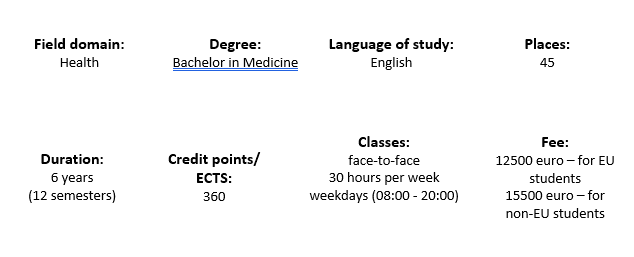
The academic year is structured in two semesters of 14 weeks each, with an average of approximately 30 hours per week. Classes are held on weekdays from 08:00 to 20:00. Each semester carries 30 European Transferable Study Credits (ECTS).
The study program consists of required and elective courses, divided into two blocks:
Preclinical subjects (1st to 3Road year
The preclinical curriculum is based on the foundational theoretical subjects from the basic sciences (anatomy, histology, physiology, medical chemistry, and biochemistry) and humanities (philosophy, psychology, languages), as well as disciplines related to pathological conditions and processes.
Preclinical disciplines are held on the IOR campus:
- anatomy laboratory – a modern laboratory, of our own design
- Physiology and Pathophysiology Laboratory – equipped with modern equipment and materials necessary for study
- Laboratories of histology, cell biology, and genetics – fully equipped with quality equipment specific to current necessary standards
- biochemistry laboratory – completely renovated and with modern equipment.
Clinical subjects (4the to 6the year
Clinical activity is carried out in specialized clinics with which the university has contracts. Among them, we list Monza Hospital, CF Clinical Hospital No. 1 Witting, CF Clinical Hospital No. 2 Bucharest, “Dr. Carol Davila” Central Military Emergency University Hospital, Ilfov County Clinical Hospital, “Regina Maria” Private Network, “Al. Obregia” Prof. Dr. Psychiatric Clinical Hospital, Efigia Clinic, “Dr. Victor Babeș” Clinical Hospital, and “Nicolae Malaxa” Clinical Hospital. These facilities have numerous clinical departments, equipped to European standards with state-of-the-art equipment and academic education facilities.
Syllabus of study program Medicine in English.
Teaching methods
Titu Maiorescu University believes in establishing strong student-professor relationships through an interactive environment that allows students to connect with their peers and professors. Thus, medical studies take place in small groups of no more than 15 people, and for each year of study, a professor is appointed as a tutor to provide advice and teaching support to the students enrolled in that respective year.
In the Faculty of Medicine, professors utilize various teaching methods, depending on the subject matter. It is highly probable that medical students will encounter each of the following methods:
- Traditional learning (seminars, lectures, dissection), based on following a certain curriculum for pre-clinical and clinical classes
- integrated learning, based on combining theory and clinical practices
- Problem-based learning, based on mixing student group work with self-directed learning
- inquiry-based learning, based on students’ own learning
We aim to equip our students with all the necessary skills to confidently practice the medical profession, including academic competence, communication and leadership skills, lifelong learning abilities, proficiency in information technology, teamwork aptitudes, and empathy.
Coursework and Assessment
Courses are assessed using a wide range of methods across the many years of study, including: anatomy practice, online tests, reflective essays, simulation exercises, verbal presentations, written assignments, viva voce, and written exams.
There are two important steps during the 6 years of study: one at the end of the 2nd year and the other at the end of the 4th year.and year of study and one at the end of the fourth yearthe year of study. The steps consist in the mandatory request for students to have no outstanding credits (exams) from previous years in order to progress to the 3rdRoad year of study, respectively the 5ththe Year of study (having passed all classes and exams from previous years) - 1st and 2and, respectfully 3Road and 4the).
The 6-year medical study program is completed by a bachelor's exam (graduation exam).
Faculty amenities
The faculty has state-of-the-art educational spaces: amphitheaters, classrooms, seminar and reading rooms equipped with smart whiteboards, a library, a publishing house, a bookstore, specialized laboratories with state-of-the-art equipment, medical equipment, a computer network, video conferencing equipment, etc.
In the 2021-2022 academic year, a new building was put into service on the IOR campus. This new space, built to the latest and highest architectural standards, features 5 amphitheaters, 20 laboratories for basic preclinical disciplines, seminar rooms, and a restaurant/cafeteria for both students and faculty.
A new clinical hospital of Titu Maiorescu University is being arranged and compartmentalized on the IOR campus. In this modern space, equipped to international standards, many disciplines, both medical and surgical, will carry out their clinical activity.